Insights · Data Study 2026
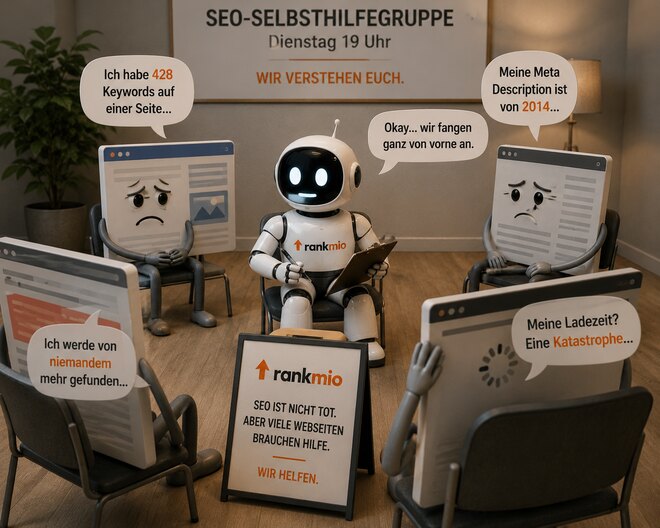
Reality Check 2026: why 7 of 10 websites are practically invisible to ChatGPT

Backed by HTTP Archive Web Almanac 2024 — and hundreds of Rankmio audits. The honest state of the web, without sugar-coating.

Key findings

Data study on 16.9 M websites (HTTP Archive Web Almanac 2024) combined with 729 Rankmio audits (Jan–Jul 2026). The core result: seven of ten websites fail AI visibility, 99 % lack FAQ schema, only 41 % of the web uses JSON-LD. Full methodology below.

Your customer types a question into ChatGPT. Four competitors get cited. Your website doesn’t appear. Not because you’re worse. But because your site speaks the wrong language — the language of machines.

The analysis of Rankmio audits shows: this is not the exception, it is the norm. Combined with the neutral reference of the industry — the HTTP Archive Web Almanac 2024 covering 16.9 million websites — a clear picture emerges.

What follows is an inventory of five structural weaknesses that affect the majority of the web. Each finding is backed by two independent data sources.

72 %
of audited websites fail AI visibility (score < 70/100).
Rankmio audits 2026
99 %
of examined pages use no FAQ schema markup.
Web Almanac 2024 · 0.6 % adoption
59 %
of websites deploy no JSON-LD structured data.
Web Almanac 2024 · 16.9 M sites
100 %
of product pages in Rankmio audits lack FAQ schema.
Rankmio GEO Page Scores · n=17

Methodology How this study was conducted

Two independent data sources combined: a broad public dataset (Web Almanac) and a targeted proprietary audit set (Rankmio). Overlap validates each other.

Data collection period

Rankmio audits: January to July 2026. Web Almanac reference: June 2024 crawl, published November 2024.

Sample size

Rankmio: 74 external domains, 85 free-check reports, 729 individual pages with detailed GEO page scoring. Web Almanac: 16.9 million websites, crawled desktop and mobile.

Industry distribution (Rankmio sample)

Mixed B2B and B2C: online commerce, professional services, medical practices, mid-sized manufacturing, agency client projects. Predominantly German-speaking market.

Data sources

Web Almanac SEO and Structured Data chapters (public, methodology documented). Rankmio Free SEO Check aggregate and GEO Page Score analysis (proprietary, page-level signals).

AI Visibility score definition

Composite score (0-100) combining structured data completeness, entity linking, author attribution, freshness signals, and topical coverage. Threshold for «visible»: ≥ 70.

Citability score definition

Sub-score (0-100) measuring the probability of being cited as source by generative AI. Weights source authority, quotability, factual density, and machine-readable structure.

Limitations

The Rankmio sample is not randomly selected — it reflects websites whose operators actively sought an audit and therefore tend to have SEO awareness. Real-world numbers on unaudited sites are likely worse. Web Almanac data is global and may vary by region. Both sources are snapshots and do not track individual sites over time.

Five structural weaknesses across the web

The Rankmio audit sample and the Web Almanac public dataset converge on the same five structural weaknesses. Where both sources measure the same signal, deviations are small and confirm each other.

Web Almanac 2024 vs. Rankmio audits — percentage of pages with the issue
No JSON-LD
59 %
27 %
No FAQ schema
99 %
37 %
Alt text missing
42 %
49 %
No canonical
31 %
24 %
H1 issues
30 %
20 %
Web Almanac 2024 Rankmio 2026
59 %

no JSON-LD structured data

In Rankmio audits, Schema.org markup is missing on every fourth customer. Google and AI systems literally don’t know what the page is about.

Source: Web Almanac 2024 (16.9 M websites)
99 %

no FAQ schema

FAQPage adoption is at 0.6 % globally. On product pages in Rankmio audits: 100 % without FAQ schema. On legal pages: 83 %.

Source: Web Almanac 2024 + Rankmio
42 %

images without alt text

Almanac median: 58 % of images have alt text — so 42 % don’t. In our audits, 49 % of pages show broken alt attributes. Congruent.

Source: Web Almanac 2024 + Rankmio
31 %

no canonical tag

Almanac: 31 %. Rankmio: 24 %. That means Google guesses which URL is canonical — and often guesses wrong.

Source: Web Almanac 2024 + Rankmio
30 %

no single H1 tag — or several

Almanac: 30 %. Rankmio: 20 %. Google and LLMs read the H1 as „what is this actually about“. Without it, the machine decides on its own.

Source: Web Almanac 2024 + Rankmio

Why this hurts

These numbers aren’t cosmetics. They are the reason many websites carry good content and remain invisible in AI-generated answers. The data can be illustrated with a simple analogy:

Imagine a library where the books have no spines. The content is excellent, but no one can figure out what’s on which page. That is a website without Schema.org, without clean headings, without structural signals.

For Google, this is inefficient. For ChatGPT and Perplexity, this is the end of the journey.

Classic search engines crawl and guess. Generative AI systems require clear signals: What is this? Who says so? When? For whom? Without answers, the machine chooses the sources on its own — usually not in favour of the missing site.

Where it hurts most

Not all page types are equally affected. We broke down 729 audited pages by category. The results are counter-intuitive.

Product pages

  • 100 % without FAQ schema
  • 24 % without structured data
  • 24 % under 300 words of content

Legal pages

  • 83 % without FAQ schema
  • 38 % low AI-Readiness score
  • 17 % thin content

Blog / content

  • 0 % without structured data
  • 17 % without FAQ schema
  • lowest error rate overall

The irony: the pages meant to sell (products) are worst documented. The pages that should signal trust (legal) practically don’t exist for Perplexity and Gemini. Blog content — where you might expect the biggest gaps — is the strongest area. The care that flows into editorial content is apparently higher than for transactional pages. If you’re wondering where to start: not with the blog. With the money pages.

The harder part: AI visibility

Classic SEO mistakes are uncomfortable. But the part that really hurts is new.

72 % of all websites we audit fail to reach 70/100 AI Visibility points. 68 % fail on the Citability score. Seven of ten websites are practically invisible to ChatGPT, Perplexity, and Gemini — even if they rank third on Google.

The Web Almanac confirms this indirectly: only 1.77 % of pages use Article schema, only 1.5 % Product schema. When AI systems scan the web for citable sources, they find nothing to hold onto in 98 % of cases. If you’re among those, the AI picks other sources — and you’re missing from the answer.

That’s the real 2026 problem: Google ranking still matters. But it’s increasingly a side discipline.

What to do — three levers

The audit data indicates three levers with the highest impact-to-effort ratio. They address the structural gaps identified above.

Step 1

Equip product and legal pages with schema + FAQ

Mechanical work, but the effect is huge. Rankmio detects which pages have schema gaps and generates the JSON-LD markup directly from existing content.

Content Studio →
Step 2

Fix internal linking

20 % of pages have fewer than two internal links, 11 % are complete orphans. Rankmio’s link graph shows where the bridges are missing.

Link Graph →
Step 3

Measure AI visibility — don’t guess

The citation tracker weekly checks whether your domain gets cited by ChatGPT, Gemini, Perplexity and Claude. Only measurement enables improvement.

Citation Tracker →

The websites visible in 2026 weren’t visible in 2023.

The advantage doesn’t sit with the giants — it sits with those who realized first that search has shifted. You can see that shift as a threat. Or as an open window. Because as long as the competition still ignores the numbers, you have time. Just not forever.

Run your own reality check →

Frequently asked questions

Google ranking and AI visibility are separate disciplines. Google ranks by position, backlinks and user signals. AI systems like ChatGPT and Perplexity choose citation sources by structural signals (Schema.org, author attribution, entities). A website can rank third on Google and never appear in a ChatGPT answer — because it sends no signals for citability.
From Rankmio audits, the average is 56 of 100 points. 72 percent of all audited domains score less than 70. That applies across all page types — landings, content and product pages combined.
The most important first step is a technical audit that identifies Schema.org gaps and internal linking problems. Rankmio does both in one pass and prioritizes results by effort-to-benefit.
Product and legal pages statistically have the biggest gaps (100 percent and 83 percent without FAQ schema in Rankmio audits). Blog content is usually better maintained. Optimize transactional money pages first, then legal, then content.
Web Almanac 2024 analyzed 16.9 million websites globally. For most categories the numbers are transferable — with one exception: alt text and canonical adoption are slightly better in German Rankmio audits than the global median, likely due to stricter privacy- and accessibility-driven environments.
Not necessarily. The effort lies mainly in structural changes (Schema.org, clean headings, entity linking) that are one-time and long-lasting. Ongoing costs arise for monitoring — with Rankmio pay-per-use, no monthly subscription.

Sources & methodology

Free SEO & GEO Check

SEO score, AI visibility and citability of your website in 30 seconds — no registration required.

Check for free now

Ready to optimize your website?

Register for free, get 10 credits and start right away.

Register now

Related glossary terms

FAQPage-Schema Canonical Tag GEO (Generative Engine Optimization)