SEO data is not yet a recommendation
A good SEO analysis starts by delivering information. It shows, for example, which search queries bring a website impressions and clicks, which keywords rank well and where there is still potential. It also shows which pages are gaining or losing visibility, which topics competitors cover that are missing from your own website, and where technical or content weaknesses exist.
That is an important foundation. But this information still has to be turned into a sensible decision.
An example: a website gets many impressions for a keyword but only a few clicks. An SEO tool might recommend revising the page title and meta description. That can be right. But perhaps the content does not match the search intent. Or the impressions come from automated queries and say nothing about real demand.
A good tool therefore does not create tasks blindly. It puts data into context, takes connections into account and explains its recommendations in a way you can follow.
Not every anomaly is a problem. And not every problem needs a new article.
A new page is only worth it if no existing page can carry the topic
One of the most important tasks in SEO is finding relevant topics for which a website does not yet offer suitable content. Collecting as many keywords as possible is not enough. These questions decide:
- Is there recognisable search demand for the keyword?
- What search intent lies behind it?
- Is there already a suitable page, and does it cover the topic sufficiently?
- What content do competitors offer on this topic?
- Does a new page make sense, or would it compete with existing content?
The last question is often underestimated. Suppose a website already has a detailed guide on a topic, and further relevant search terms now appear. Automatically deriving new articles from them is not necessarily the best decision. Often it is enough to extend the existing content, add a missing section or improve the structure.
A good SEO tool therefore distinguishes two paths. New content is created when a relevant topic is not yet covered sufficiently on the website. Existing content is optimised when there is already a suitable page that can be improved in content or structure. This prevents unnecessary pages and develops the existing website in a targeted way.
Ranking signals call for a response, not just observation
Rankings change constantly. New competitors appear, search intent evolves, and Google changes how it presents its results. An SEO tool should not just document such changes but help derive concrete actions from them.
| Observation | Possible action |
|---|---|
| A page loses rankings | Review content and the competitive situation |
| Many impressions, few clicks | Check the search result display and search intent |
| A keyword reaches page two | Improve the existing content in a targeted way |
| New relevant queries appear | Check for a content gap |
| Competitors gain visibility | Analyse their content and topics |
A recommendation does not have to trigger an action automatically. A ranking change can have various causes. A tool provides pointers and makes connections visible so that the user can decide on a sound basis. The decision about implementation remains an editorial and strategic task.
Competitors show where new opportunities lie
Looking at your own website in isolation is not enough for a good SEO strategy. Competitors show which topics matter in an industry, which content works well and where new opportunities arise.
This is not about copying successful content. These questions are more interesting:
- Which topics do competitors cover that are missing from your own website?
- For which search queries are they gaining visibility?
- Which content fits the search intent particularly well?
- Where can a topic be covered better, more clearly or more thoroughly?
Insights like these lead to concrete content ideas. Ideally, an observation does not end up in yet another spreadsheet but directly as a task you can check in your own SEO workflow.
The next step leads from the SEO tool straight into the Content Studio
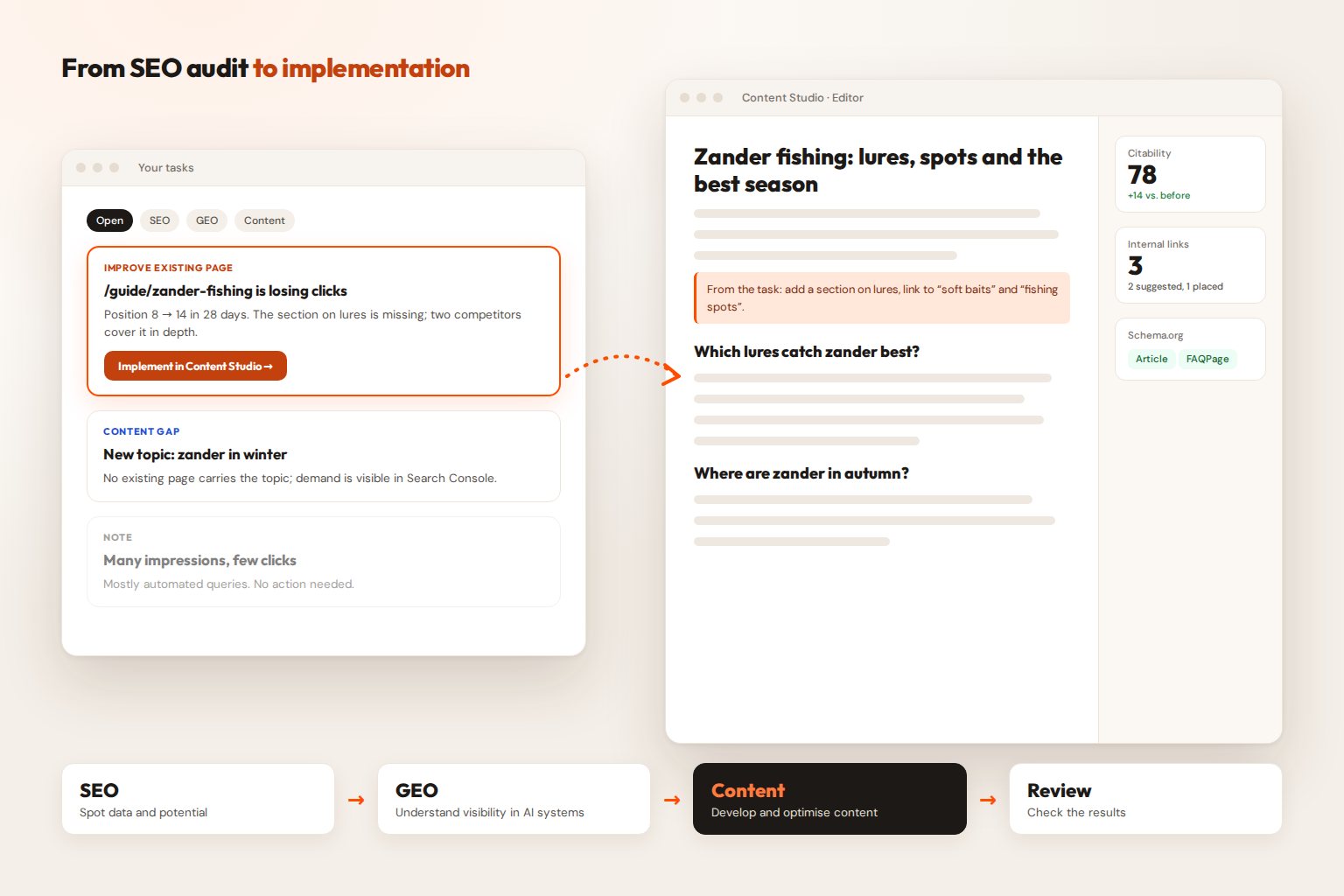
This is where a classic analysis tool differs from a continuous SEO workflow. When a tool recommends an optimisation, the next step should be easy. Today the user often copies a URL, opens another tool, imports the content and explains there by hand what should improve.
A continuous process looks different:
- The SEO tool spots an opportunity for optimisation.
- The user reviews the recommendation and decides on the action.
- The existing page is loaded straight into the Content Studio.
- The content is analysed and revised in a targeted way.
- Where there is a real content gap, a new article is written instead.
- The results are then checked again against the SEO and GEO data.
This turns an isolated analysis into a connected workflow.
A Content Studio has to do more than generate text. It takes into account the existing content, the audience, the search intent and the requirements of editorial quality. That includes a sensible article structure, relevant topics and questions, suitable internal links and appropriate structured data such as Schema.org markup.
The goal is not to produce as many texts with AI as possible. The goal is better content with fewer unnecessary steps.
SEO and GEO belong together
Classic Google search remains an important part of organic visibility. At the same time, AI-powered search systems and answer engines such as ChatGPT, Gemini and Perplexity are gaining ground. This also changes the question of how content should be structured.
It is no longer enough to look only at a keyword and a good position in the search results. Content has to be clear and well founded, and prepared so that search engines and AI systems can understand its statements. That includes:
- clear answers to the specific questions users ask,
- traceable information and sources,
- an understandable structure,
- depth and recognisable expertise,
- meaningful semantic connections,
- suitable structured data.
A modern SEO tool therefore does not treat SEO and GEO as two separate tasks. Analysing visibility, developing content and checking the results afterwards interlock.
This is how Rankmio connects SEO, GEO and content
This is exactly the approach Rankmio takes. Rankmio is an SEO and GEO platform that connects analysis, recommendations and content creation. Instead of only providing data and reports, Rankmio helps turn the findings into concrete actions.
- The SEO and GEO analyses examine the visibility of a website and its content, in Google as well as in AI systems.
- The Google Search Console connection brings search queries, impressions, clicks and positions into the analysis.
- The gap analysis shows topics for which a new page has potential.
- The task list turns detected optimisation opportunities into concrete tasks with reasons.
- The competitor analyses track the visibility and topics of other websites.
- The chat assistant answers questions about your web projects and makes recommendations based on the available project data.
- In the Content Studio you revise existing pages or develop new articles.
- Rankmio creates suitable Schema.org structured data for the content as well.
An example of the practical benefit: you ask the chat assistant which keyword suits your next article. Instead of just returning a list of search terms, Rankmio can take your existing content into account, assess search volume and search intent and make a recommendation. Perhaps a new topic makes sense. Perhaps an existing article should be extended instead. Exactly this distinction is what makes a good recommendation.
What you should look for when choosing an SEO tool
Not every SEO tool has to do everything. Specialised tools deliver excellent results in individual areas. But if you regularly do SEO work for several websites, you should check how well the individual steps fit together. These questions help with the assessment:
| Question | Why it matters |
|---|---|
| Does the tool detect relevant content gaps? | So that new topics are not left to chance. |
| Does it distinguish new content from optimisations? | So that no unnecessary pages are created. |
| Does it take existing rankings and content into account? | So that recommendations are based on the actual website. |
| Does it derive concrete tasks? | So that analyses turn into actions you can carry out. |
| Is a Content Studio integrated? | So that analysis and implementation are not needlessly separated. |
| Does it support GEO? | So that visibility in AI search systems counts too. |
| Are recommendations traceable? | So that you stay in control of your decisions. |
So the decisive question is not just how much data an SEO tool delivers. It is how much work it actually takes off your hands.
SEO should not stop at the analysis
A good SEO tool does not just show you where your website stands. It helps you see what you can improve, which content is missing and which actions actually make sense. It gets even better when you can carry out these actions directly, without constantly switching between different applications.
The ideal workflow therefore connects four steps:
| Step | What happens |
|---|---|
| SEO | Spot data and potential |
| GEO | Understand visibility in AI systems |
| Content | Develop and optimise content |
| Review | Check the results |
SEO → GEO → Content → Review
Rankmio connects these steps in one platform, with an integrated Content Studio, chat assistant and task list. You can register for free and start with 10 credits. There is no subscription and no contract, and you pay with credits only for the features you use.
Frequently asked questions
What does it cost to get started with Rankmio?
Registration is free, and you start with 10 credits. There is no subscription and no contract. Credits are only deducted when you use a feature that costs something.
Does Rankmio automatically create a new article for every content gap?
No. Rankmio shows the gap, and you decide whether it becomes a new article or the revision of an existing page. Before writing, it is worth checking whether an existing page already carries the topic, because a second page on the same topic competes with the first.
Can I revise an existing page directly from a task?
Yes. From a task, the Content Studio loads the affected page into the editor, and the note from the task comes along. You then transfer the revised text to your CMS or send it directly to WordPress.
Do I need Google Search Console?
Not to get started. Many analyses work with the crawl of your website. Search queries, impressions, clicks and positions, however, only come from Search Console. With it, the recommendations become considerably more precise.
What does GEO mean?
GEO stands for Generative Engine Optimisation, the optimisation for AI systems such as ChatGPT, Gemini and Perplexity. Rankmio measures two things for it: how citable your pages are, meaning whether they meet the requirements for being cited, and the actual citations, meaning how often AI systems name your website in their answers.
Does Rankmio replace specialised SEO tools?
Not in every case. Specialised tools can go deeper in individual areas. Rankmio is meant for everyone who wants analysis, tasks and implementation in one place instead of switching between several applications.